1799 – 1847
Mary Anning
Palaeontologist
Fossilist
Marine Reptiles
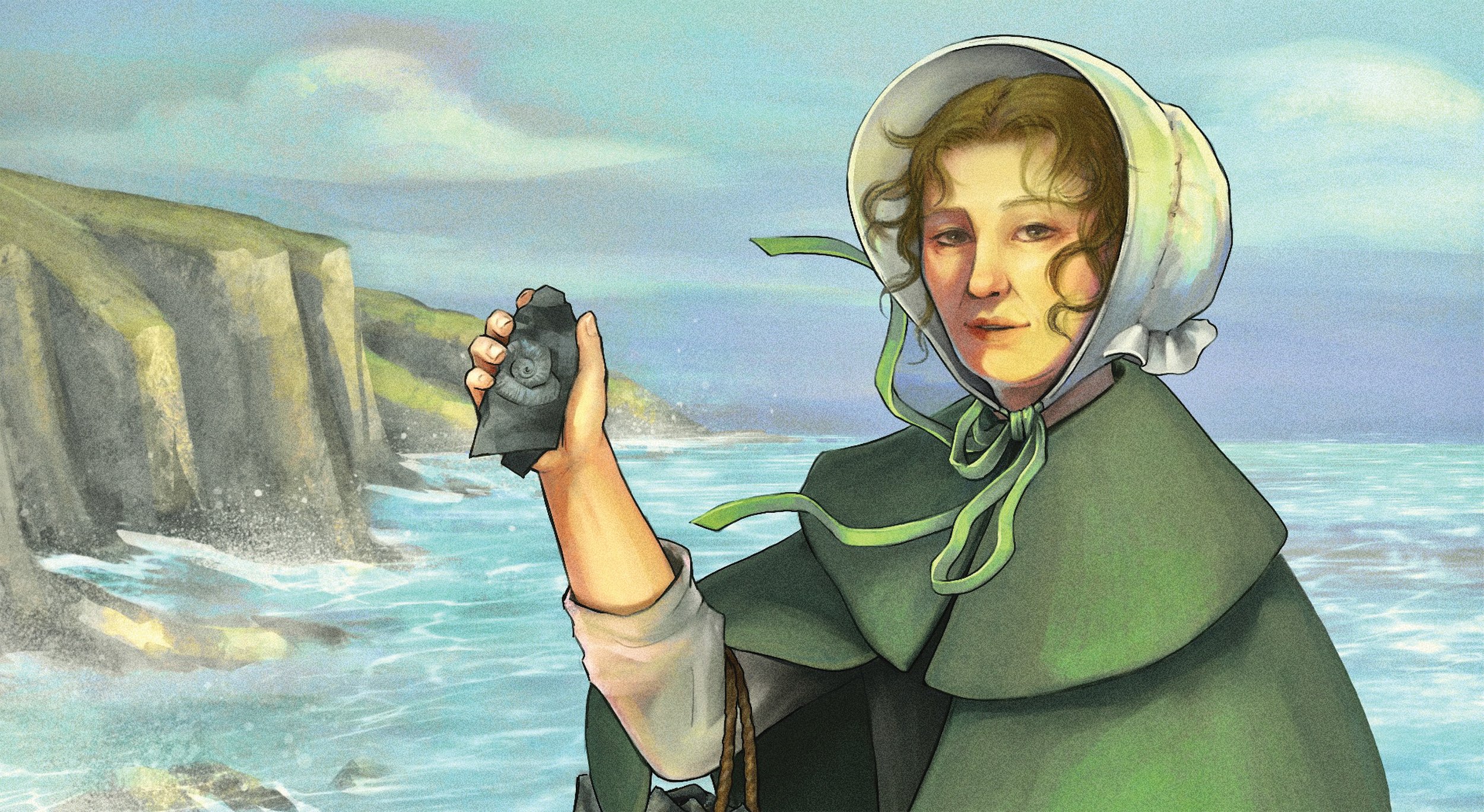
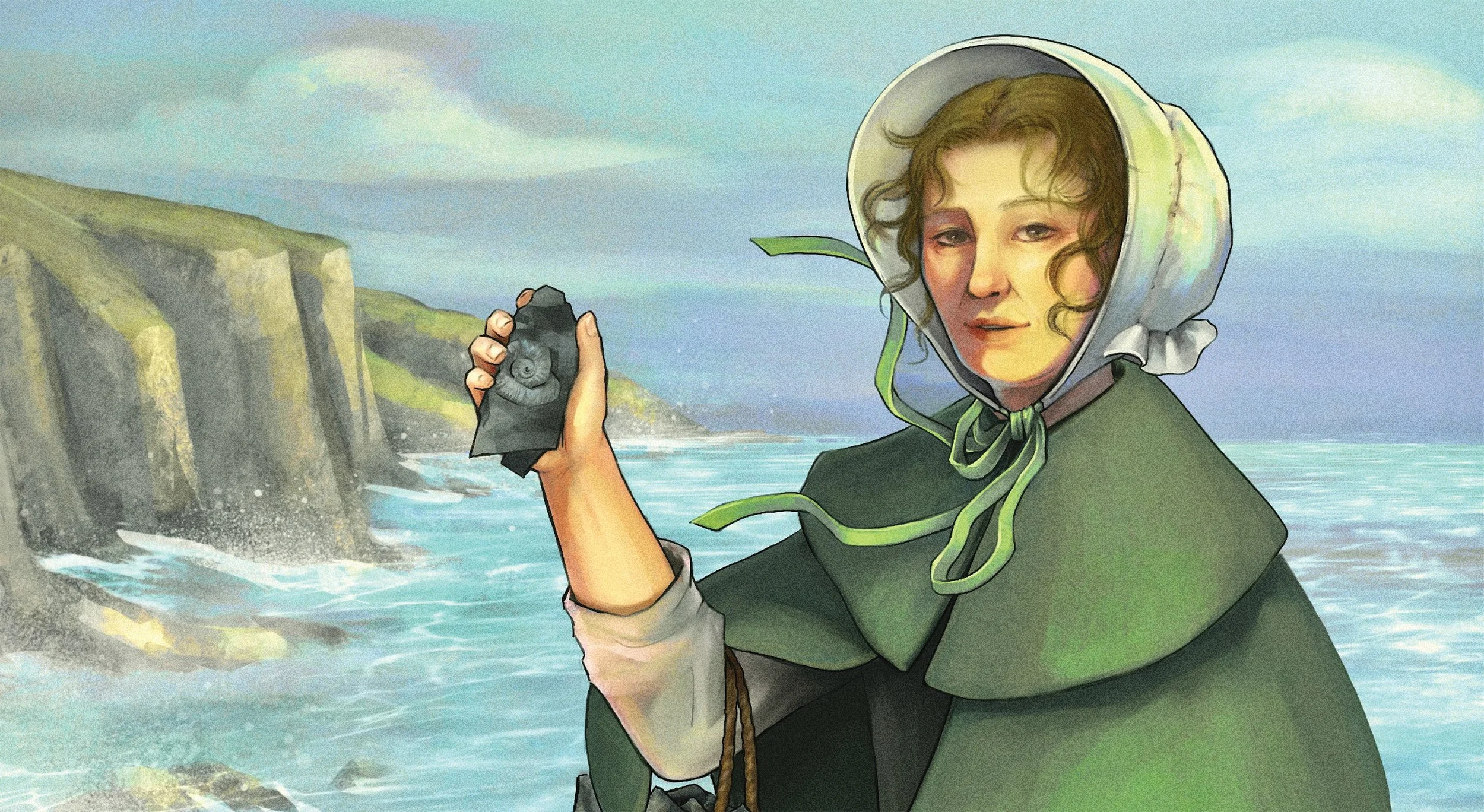
Portrait of Mary Anning.
Two voices that history left unconnected: one real, one imagined.
Unpredictable Gifts at the Edge of the SeaMary Anning’s story begins on a shoreline where survival was never guaranteed.
She was born in 1799 in the coastal town of Lyme Regis, on the Dorset coast, where the sea and cliffs seemed locked in a state of perpetual collapse. In this climate, Anning’s parents, Richard Anning and Mary (Molly) Moore, were Dissenters, English Protestants outside the Church of England, religious outsiders whose small carpentry business and trade in fossil curios helped sustain the family through hard winters. At the edge of the sea, the family lived with storms at their doorstep. When the tide retreated, it left behind fragments of another world: ammonites, belemnites, and vertebrae polished by time. From these remnants, the family fashioned a livelihood out of the fragile and unpredictable gifts of the shore.
When Anning was fifteen months old, she was taken by a neighbour to watch a travelling company of horsemen perform in a nearby field. During the show, lightning struck the elm tree under which they stood, killing the three women beside her. Anning was the only one to survive, and she was later revived after being carried home and placed in warm water. The incident soon became part of local lore, and neighbours claimed that the frail child who survived seemed to grow brighter and more curious as she recovered. Whether or not the lightning altered her, the story endured as an uncanny preface to her life. Again and again, she would return to places marked by danger and find there what others had failed to see.
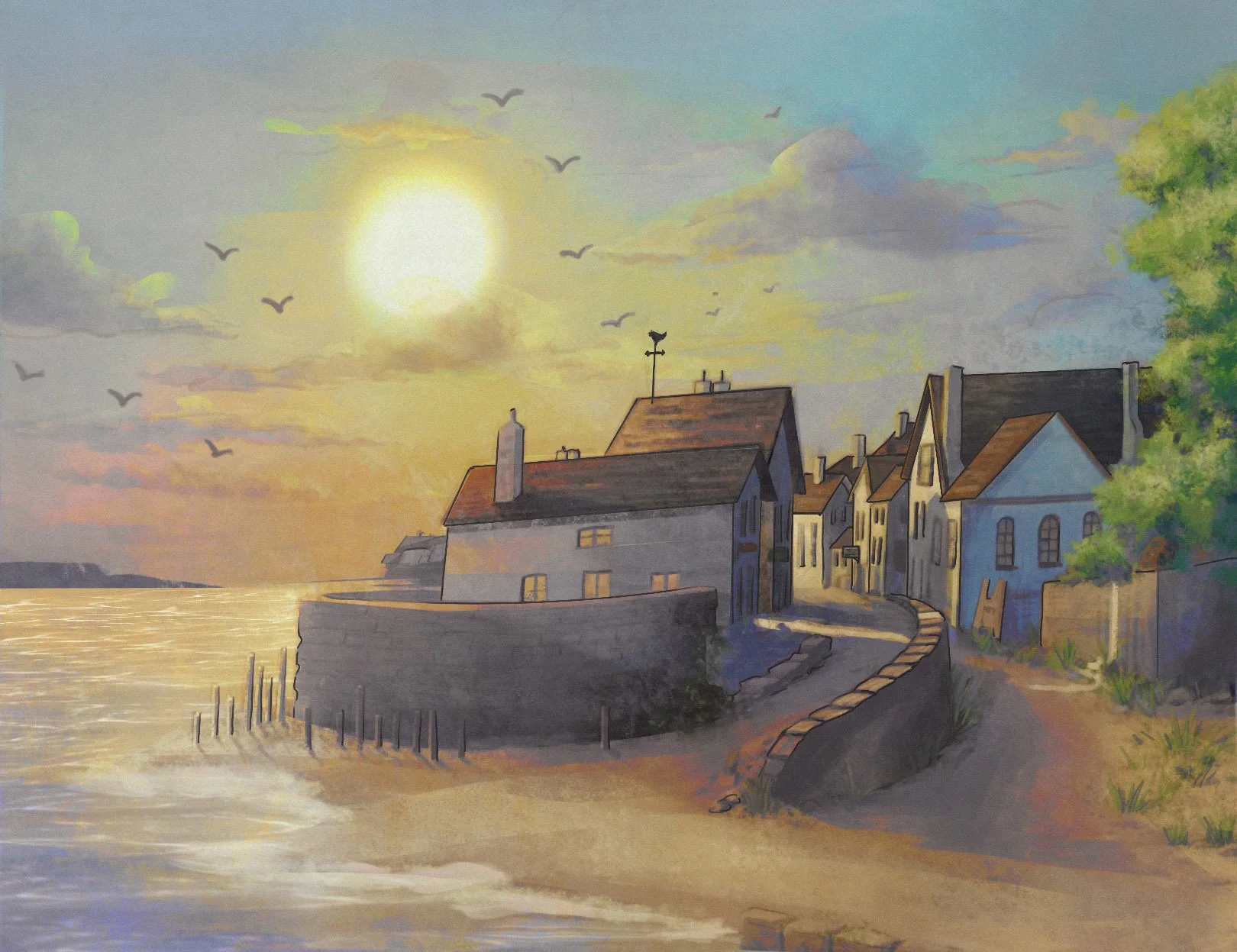
Illustration of Mary Anning’s seaside home in Lyme Regis, where daily life unfolded at the edge of storm, tide, and discovery.
The Annings’ faith placed them on the margins of English society. As Dissenters, they could not attend university or hold public office. Their poverty deepened that sense of exclusion. Richard, who taught his children to read the strata, the layers of rock that recorded the passage of time, as carefully as scripture, died when Anning was eleven, leaving debts that forced the family onto parish relief, a modest form of local welfare provided through the parish to those too poor to survive without assistance. With few options left, Anning’s mother kept the family afloat as best she could, while young Anning learned early that survival depended on close attention: to weather, to stone, and to the narrow opportunities the shore could provide.
Cabinet of CuriositiesAfter Richard Anning’s death, the family business shifted from carpentry to the commerce of stone. Moore and her children set up a small table of “curiosities” near the coach stop in Lyme Regis, offering fossils to visitors who came in search of seaside air and diversion. Their customers called the ammonites “snake-stones” and the belemnites “devil’s fingers,” names that belonged more to superstition than to science. To the Annings, however, these objects were neither quaint nor mysterious. They were specimens, stock, and sometimes supper.
Tourists bought the fossils as trinkets, unaware that the child who sold them could already tell the difference between a vertebra and a shell. Anning spent her days at the base of the cliffs, hammer in hand, where rain loosened the rock, and the tide carried debris away.
Collecting was perilous work. The ledges were unstable, and landslides were frequent. Poverty posed dangers of its own. Every successful find offered the possibility of another day’s income.
Lyme Regis itself also began to change. Fossil hunting became fashionable among visiting natural philosophers, who arrived with notebooks and curiosity but seldom with credit. Anning’s small shop evolved into a modest museum of its own, its walls lined with vertebrae, shells, and ammonites arranged by form and size, becoming an accidental precursor to the public museums that would soon shape Victorian science. The cliffside child had become a curator of a new kind of cabinet, one that held not souvenirs but evidence of worlds long lost.
Anatomies of StoneThe turning point came in 1811, when twelve-year-old Mary Anning and her brother Joseph uncovered the remains of a marine reptile unlike anything they had seen before: an ichthyosaur, the “fish-lizard” that would become one of the first great icons of prehistoric life. Joseph discovered the skull first along the shore, and months later Anning carefully uncovered the rest of the skeleton from the cliff face. Later identified as Temnodontosaurus platyodon, the fossil changed the family’s circumstances and widened contemporary understandings of the prehistoric world. It was sold to a local collector and later displayed in London, where it drew crowds eager to see the bones of an ancient sea creature. Yet the children who uncovered it received little recognition.
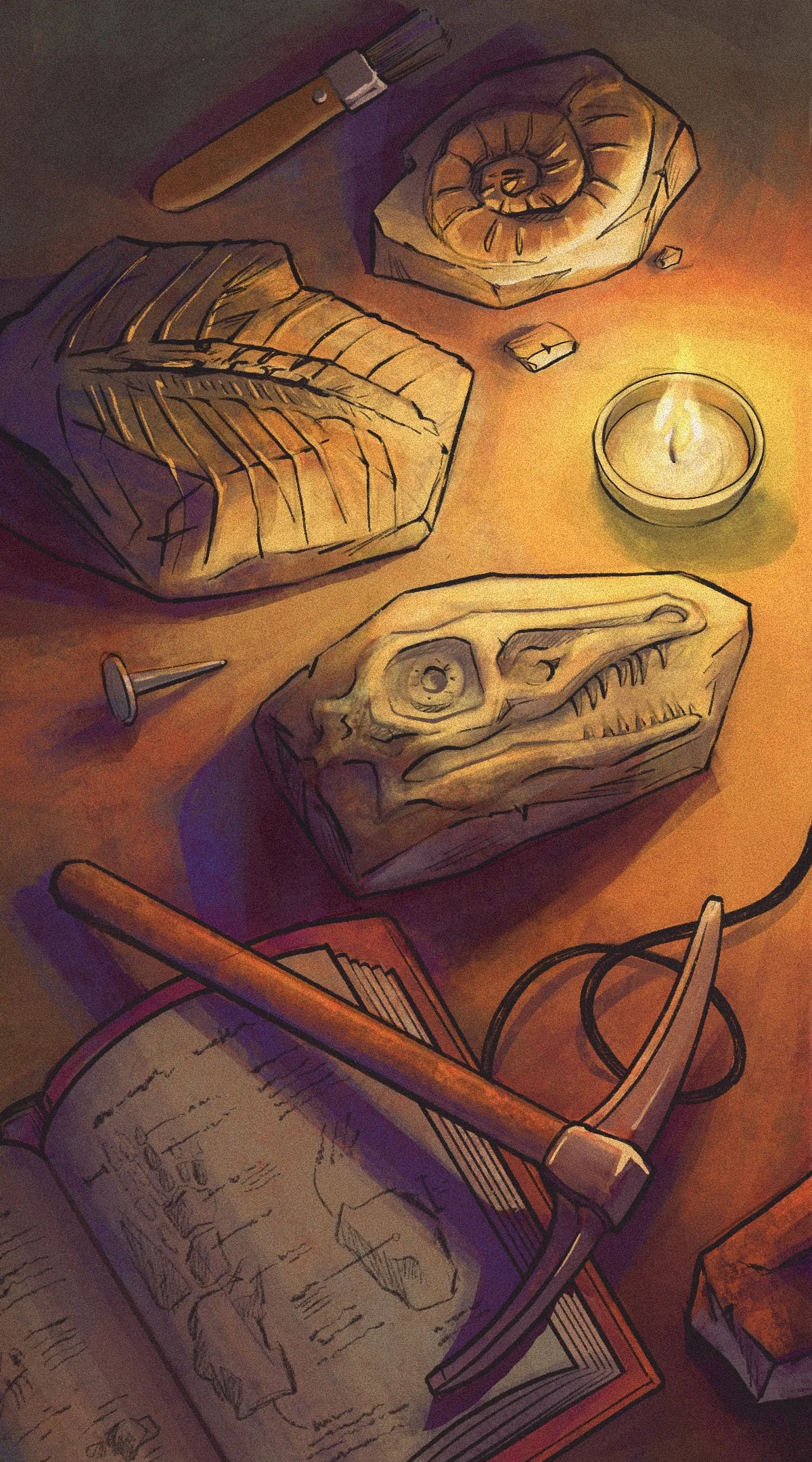
Illustration of Mary Anning’s kitchen worktable, laid out with fossils, ammonites, tools, notebook, pickaxe, and candlelight, the materials through which she pieced ancient life back together.
Before a specimen left her shop, she often recorded it in detail, preserving on paper what might later pass into a private collection or museum beyond her reach. She also developed careful methods of reconstruction, fixing bones into position and assembling skeletons with a precision that made scientific study possible.
By her twenties, Anning had learned to read the language of bones as easily as others read scripture. She could identify a fossil from a single vertebra and explain its structure with remarkable precision. The men who wrote about such discoveries rarely mentioned her by name. What began as an act of survival had become a discipline of precision. She cleaned fossils with tools adapted from carpentry, using needles and whalebone to uncover each vertebra without damaging its shape. Her specimens, ichthyosaurs with rib cages curved like ship hulls and plesiosaurs with the long, improbable necks of serpents, were assembled piece by piece on her kitchen table, each fragment a syllable in the deep grammar of the earth.
She worked under conditions that demanded both patience and speed. Winter storms and rain loosened the unstable Blue Lias cliffs, exposing fossils that had been buried for millions of years, but the sea could carry them away just as quickly. Anning learned to search in the aftermath of collapse, racing the tide to recover what the cliffs released. The danger was real. In 1833, she narrowly escaped a landslide that killed her dog, Tray, a reminder that every discovery carried risk.
The Sea’s Oldest SecretsAnning’s most famous discoveries continued to test the limits of what naturalists thought possible. In 1823, she uncovered the first complete plesiosaur skeleton, a marine reptile whose extraordinarily long neck made it seem almost impossible. The discovery was notable enough to be reported in the local paper, the Western Flying Post, where Anning was credited by name. Georges Cuvier initially suspected the specimen was fraudulent, believing such a creature could not be anatomically coherent. After seeing a drawing of the fossil, he suggested it was a forgery, prompting British geologists to defend both the specimen and Anning’s discovery. Cuvier later retracted the accusation and discussed the find in print. Anning’s find proved otherwise, and the skeleton became one of the most consequential fossils of the century.
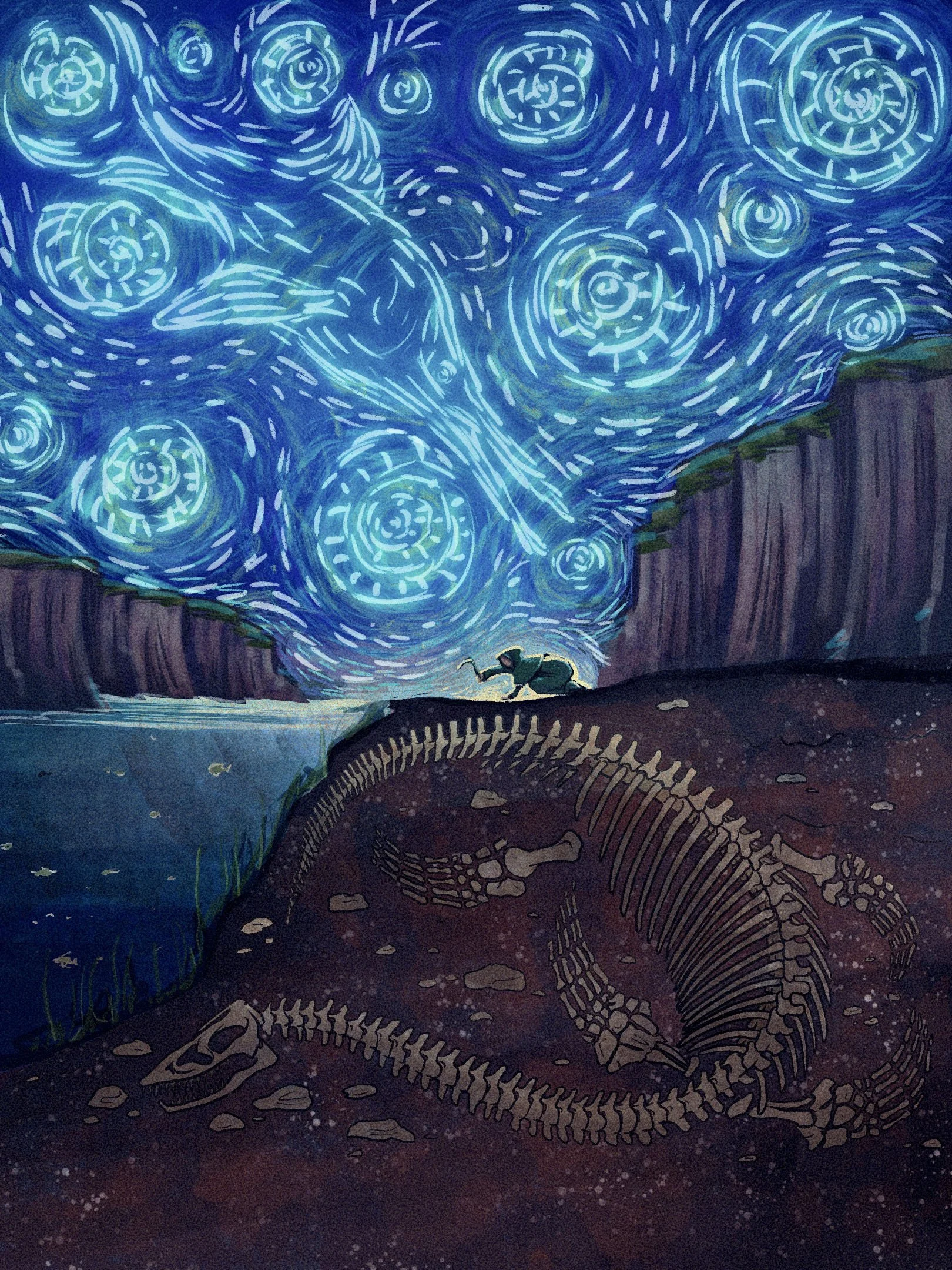
Illustration of Mary Anning at work on the Dorset coast, carefully uncovering a plesiosaur fossil beneath the earth while ammonites and an ichthyosaur hover above as visual echoes of her wider discoveries.
Two surviving letters from December 1823 offer a rare glimpse of Anning in her own voice at this pivotal moment. Written to Sir Henry Bunbury, an early member of the Geological Society of London, they preserve her not only as a discoverer, but as a careful observer, sketcher, and negotiator of her own work. In the second letter, accompanied by a rough sketch, she wrote:
The letter reveals Anning in full: anatomist, draftswoman, and scientific interpreter. She drew attention to the fossil’s “remarkable long neck and small head,” recognized that it did not fit existing conjectures, stressed its rarity, and negotiated its sale with calm precision. In her own words, she appears not as a passive supplier to science, but as an active thinker shaping how the specimen would be understood.
Anning was not content simply to recover fossils. She wanted to understand them. Her work required more than excavation. It demanded anatomy, sketching, and comparison. To identify the function of the paddle bones of Plesiosaurus dolichodeirus, she dissected fish and cuttlefish to study comparable anatomical structures. The drawings she made of fossil skeletons, copied from scientific papers borrowed or lent by visiting geologists, were so accurate that later scholars could barely distinguish her copies from the originals.
Visitors to Lyme Regis came to seek her judgment as much as her fossils. William Buckland, Henry De la Beche, and the Swiss naturalist Louis Agassiz all walked the beach with her, hammer in hand. They relied on her insight to identify which fossils belonged to which creatures and which might prove new to science. Agassiz, in particular, credited Anning and her friend Elizabeth Philpot for helping him classify fossil fish from the Dorset coast, writing that the two women “showed with utter certainty” which dorsal spines belonged to which species. Such acknowledgement was rare.
Women like Anning were seldom credited at all.
Among the discoveries that deepened her standing was the winged fossil she uncovered in December 1828: a skeleton with elongated fingers and the impression of membranous wings. Buckland named it Pterodactylus macronyx, now known as Dimorphodon macronyx, and this time acknowledged Anning’s role in its discovery. It was the first pterosaur specimen found outside Germany. A year later, Anning discovered Squaloraja polymorpha, a fossil fish thought at the time to bridge sharks and rays. Finds like these made the history of life appear stranger, older, and less fixed than many had imagined.
Lady Harriet Silvester, a London widow who met Anning in 1824, left one of the most vivid accounts of her intelligence. Silvester wrote that,
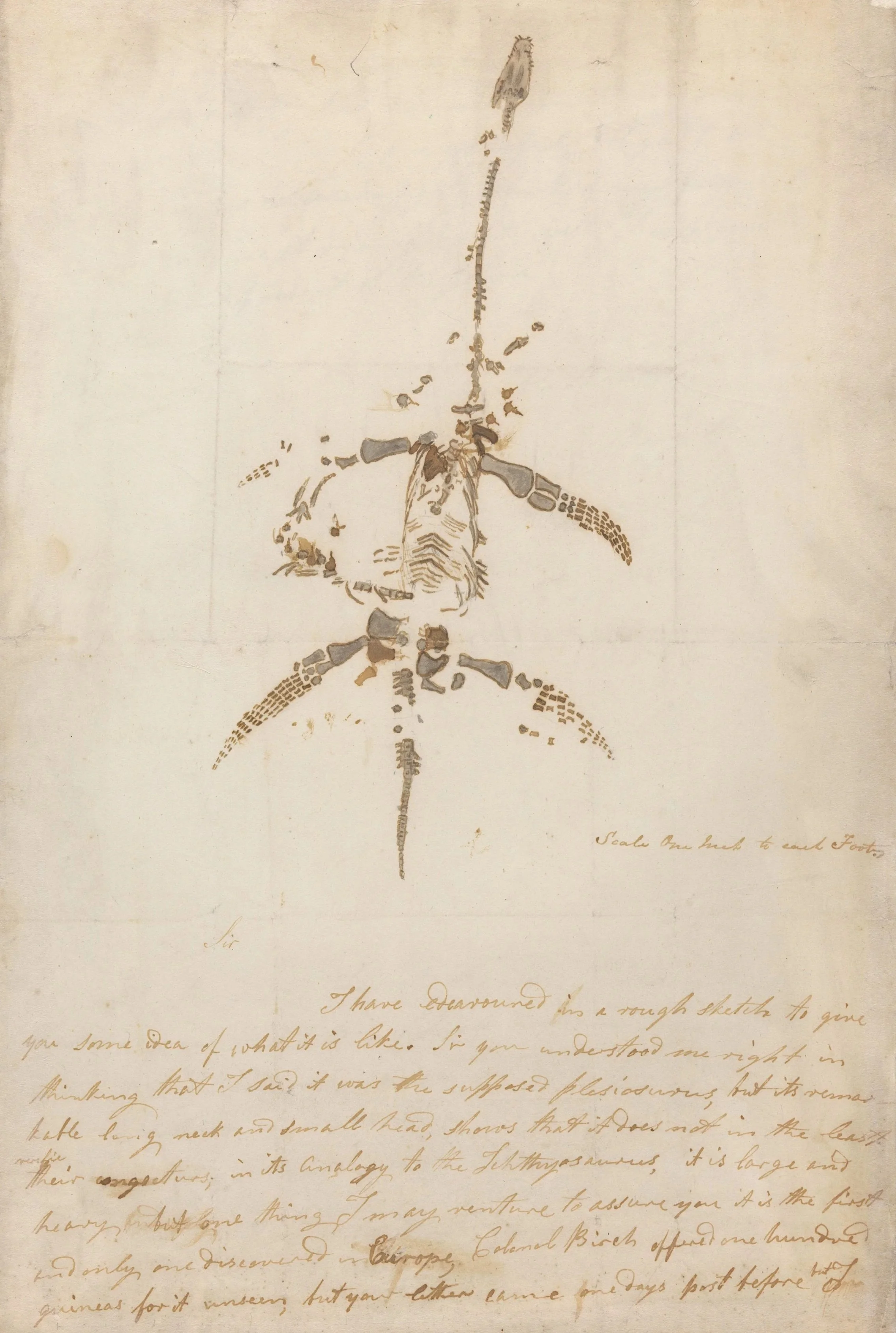
Mary Anning’s autograph letter to Sir Henry Bunbury, dated December 1823, describing her recent fossil discoveries, including the newly uncovered plesiosaur, accompanied by a pen-and-ink sketch of the skeleton.
Letter and drawing from Mary Anning announcing the discovery of a fossil animal now known as Plesiosaurus dolichodeirus, 26 December 1823
This letter captured what few scientific papers did: the achievement of a self-taught woman who had become, through study and endurance, an extraordinary practical anatomist and interpreter of fossil life.
To those who met her, she was both collector and interpreter, revealing the forms of creatures that had vanished from the world. Within science, Anning remained too often the unseen hand behind a revolution in understanding. Her fossils helped furnish crucial evidence in debates about extinction, deep time, and the changing history of life. Anning’s observations also contributed to the early study of coprolites, opening new ways of understanding how ancient marine creatures fed and lived. Her name appeared only in footnotes, if at all. The anatomies she revealed in stone rewrote the history of life, even as her own story remained buried within it.
Used So UnkindlyBy the time Mary Anning reached her thirties, her reputation had spread through the geological circles of Britain and Europe. Her name, however, remained largely absent from their publications. Many of the men who relied on her findings, including Buckland, Conybeare, and De la Beche, became Fellows of the Geological Society of London, an institution whose meetings she could not attend. Women were barred from membership, especially those without rank, money, or formal education.
Her exclusion operated at more than one level. Institutional rules kept her out, but the deeper barrier was ideological: science was still imagined as a gentleman’s pursuit. Even those who admired her often portrayed her as an exception rather than acknowledging her as a legitimate participant in the field. One of her young acquaintances, Anna Pinney, later recorded a remark that captured her frustration:
The words reveal a sharp self-awareness of how Anning’s discoveries were consumed by others. She had given Victorian science some of its most extraordinary evidence. In return, she received intermittent support, limited acknowledgement, and a great deal of silence.
Many argue that Anning’s only known contribution to the scientific literature in her own voice appeared in 1839 as an extract from a letter published in the Magazine of Natural History. In it, she corrected the editor’s mistaken claim about fossil sharks, writing,
The correction was brief, but it carried unusual force. Here, in print, Anning asserted her authority over the scientific record in her own voice.
Some later accounts suggest that Anning once stood before a museum display and saw one of her own fossils labelled with another person’s name.
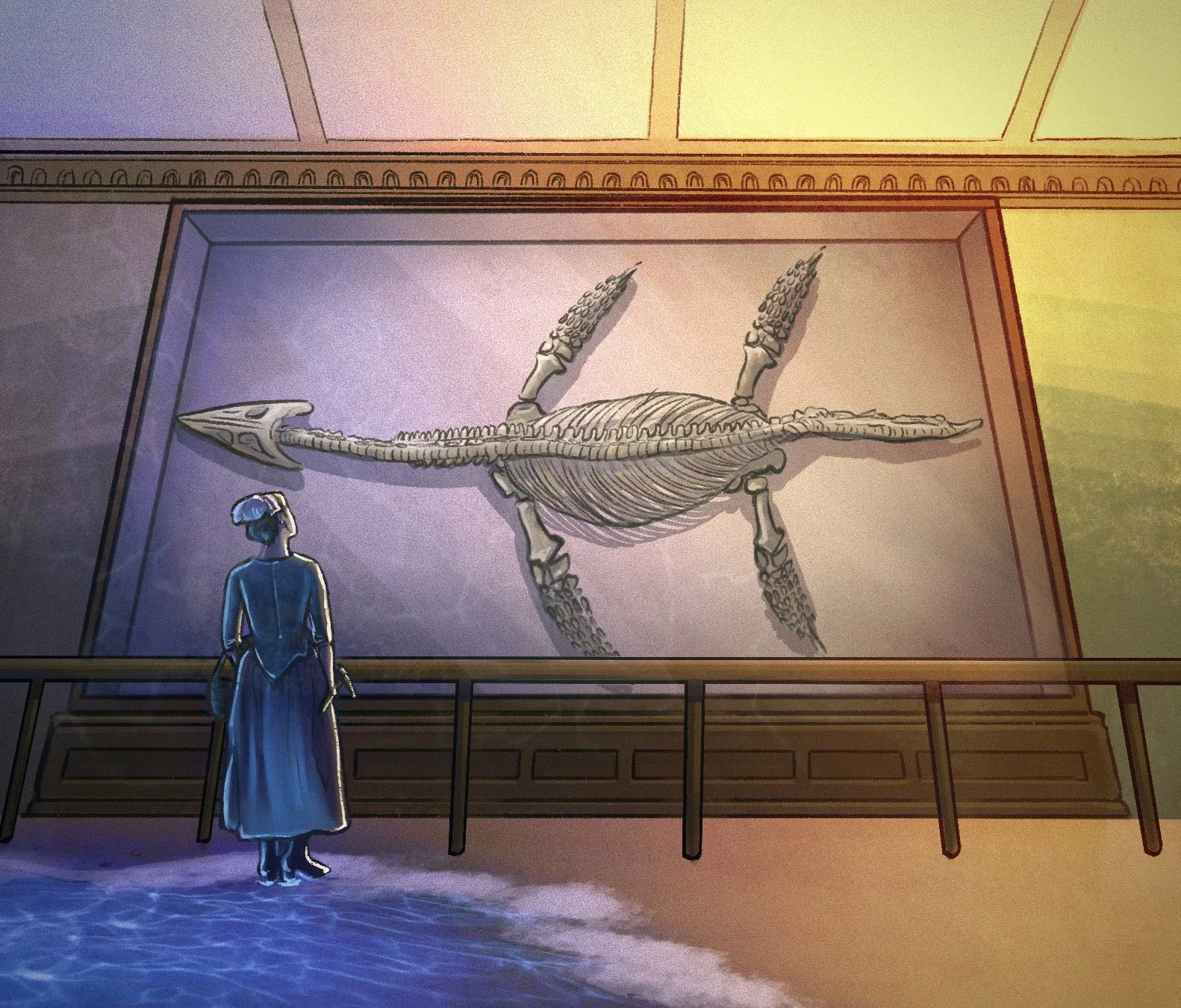
Illustration of Mary Anning standing before one of the fossils she uncovered, pickaxe in hand, as water gathers at her feet, evoking later accounts that she once saw her own discoveries displayed under another person’s name.
This scene is difficult to verify, and it is best read less as documented fact than as a symbol of a larger pattern. Fossils she discovered and prepared were often purchased by wealthier collectors, described in publications by men with institutional standing, and displayed in ways that did not centre her labour or expertise. Whether or not she ever encountered such a label herself, the larger truth remains: her work was admired, bought, and studied, but seldom credited to her. In that sense, her erasure was layered. It began in the structures of her own time and continued in the histories her labour had helped to build.
Years later, after Anning’s name had faded from much of academic memory, another version of her began to circulate in popular culture. The life that had helped redefine the deep history of the earth was refashioned, in some later tellings, as a nursery rhyme about seashells and the shore. The verse, published in 1908 by Terry Sullivan, became one of the most famous tongue-twisters in English:
Many later writers claimed the rhyme was based on Mary Anning’s life, though direct historical evidence for that connection has not been found. Whether or not she inspired it, the song’s sing-song rhythm masked a more complex truth. Its cheerful image of a woman selling shells erased the danger of the cliffs, the hunger that drove her to them, and the knowledge she brought back from their ruins. The rhyme endured because it made her small, familiar, and easy to remember. The life she actually lived was harsher, riskier, and far more intellectually consequential.
Mary Anning had lived between the worlds of commerce and science, faith and evidence, belonging and exclusion. The society that profited from her discoveries never fully made room for her in its official record. Instead, it proved more comfortable turning her into a quaint refrain for children than confronting what her life revealed about science, class, and authority. The cliffs she had risked her life to study stood as silent witnesses to her absence from the books her work had helped make possible. And if she ever doubted the justice of that silence, her own words remain the clearest answer:
Duria Antiquior: A More Ancient DorsetIn 1830, Henry De la Beche, a geologist who had known Mary Anning since childhood, took up brush and watercolour to render an idea that science was still learning to picture. His painting, Duria Antiquior, “A More Ancient Dorset,” imagined prehistoric seas alive with the creatures Anning had brought to light: Ichthyosaurus platyodon pursuing fish, Plesiosaurus dolichodeirus lifting its serpent-like neck above the waves, and Dimorphodon macronyx gliding overhead. The scene was extraordinary for both its imagination and its accuracy. De la Beche drew directly from Anning’s specimens, translating her anatomical precision into colour and motion.

Duria Antiquior, “A More Ancient Dorset,” Henry De la Beche’s 1830 reconstruction of prehistoric Dorset, inspired by Mary Anning’s fossil discoveries.
He sold prints of the image to raise money for her during another spell of financial hardship, sending the proceeds to Lyme Regis. It is often described as one of the earliest examples of palaeoart serving both public science and charitable support. What began as a friend’s gesture became a visual language for deep time, one that would help shape Victorian geology and popular thought about Earth’s past.
Anning’s discoveries had already transformed more than art. They had also strengthened emerging scientific arguments about extinction and the deep antiquity of the earth, helping geologists describe a world that long predated human history. Her Squaloraja polymorpha, a fossil fish whose features seemed to combine those of sharks and rays, challenged fixed ideas of creation. Her observations of coprolites, fossilized feces later recognized as evidence of ancient feeding habits, opened new ways of understanding the ecology of prehistoric seas. Through the strata she uncovered, she helped reveal a history of life marked by loss, change, and renewal across immense stretches of time.
For Victorian society, these implications were unsettling. Fossils once sold as curiosities now carried philosophical weight. Clergymen debated how a benevolent Creator could preside over worlds that had vanished beneath catastrophe. Artists and novelists looked to geology for new metaphors of time and decay. In this shifting terrain, Mary Anning’s work stood as quiet testimony, a physical record of change, stripped of doctrine and luminous in its detail.
When De la Beche’s painting reached London and Oxford, its vision of Dorset’s lost seas became a model for how prehistoric life might be imagined and communicated. The fossils Anning had once sold from a seaside table now fill museum halls and textbooks. She was seldom granted a place equal to the worlds she had helped uncover. A scientific culture that had often overlooked her now learned to picture the ancient world through evidence she had uncovered.
“The Greatest Fossilist the World Ever Knew”By the mid-1840s, Mary Anning’s health had begun to fail. She was diagnosed with breast cancer, and the illness gradually forced her from the cliffs that had shaped her life. Even as she grew too weak to collect, she remained a quiet authority. When visitors came to Lyme, she shared her knowledge from the doorway of her small shop, speaking of layers and formations as others might recall family stories. The Geological Society of London, whose meetings she had never been allowed to attend, organized a subscription for her care, and the newly founded Dorset County Museum made her its first honorary member.
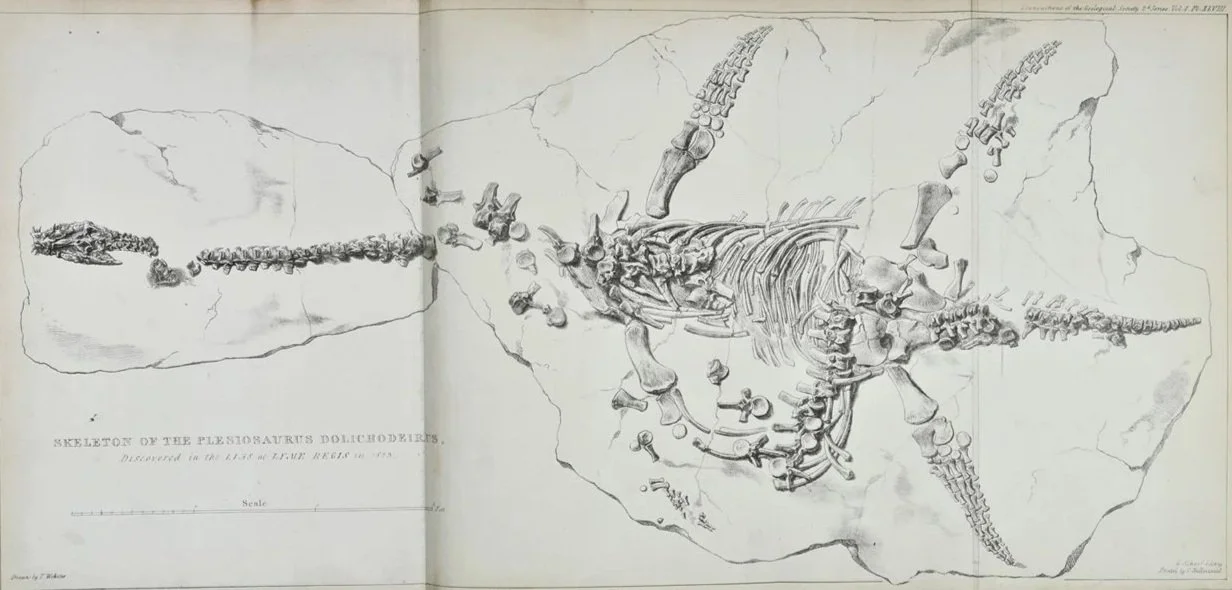
Lithograph of the Plesiosaurus dolichodeirus skeleton discovered by Mary Anning in 1823, published in the 1824 Transactions of the Geological Society of London by Thomas Webster.
Anning died in March 1847 at the age of forty-seven. She was buried at St Michael’s Church in Lyme Regis. The president of the Geological Society, Henry De la Beche, wrote her obituary for the Quarterly Journal of the Geological Society, the first obituary for a woman published in that journal.
His words were factual rather than sentimental, but they placed her, at last, within the formal record of science.
The memorial window in St. Michael’s Church, funded in part by contributions from her friends who were Fellows of the Geological Society, depicts scenes of mercy: feeding the hungry, clothing the poor, sheltering the stranger. It bears her name with the inscription that she was remembered “for her usefulness in furthering the science of geology.” The tribute was sincere, though it could not erase the exclusions that had shaped her life. The same society that commemorated her in glass had once barred her from its meetings.
After her death, Anning’s name slowly faded from wider view. For decades, she survived chiefly as anecdote: a curiosity, a local story, and later the supposed, though unverified, inspiration for a rhyme. Her influence, however, did not disappear. Modern accounts from institutions such as the Natural History Museum continue to note that her discoveries were fundamental to reconstructing ancient marine life and to changing scientific understandings of extinction and Earth’s deep past. Her observations on Ichthyosaurus platyodon and Plesiosaurus dolichodeirus contributed important evidence to nineteenth-century debates about extinction and deep time, and later informed evolutionary understandings of life’s history.
Two centuries later, the Royal Society named her among ten women in British history judged to have had the greatest influence on science. Statues now stand along the Jurassic Coast, her likeness appears in the galleries of the Natural History Museum, and her life continues to inspire books and films. Her lasting legacy lies elsewhere: in the act of discovery itself, and in the insistence that knowledge does not belong only to those born into privilege.
Along the Dorset cliffs, the strata she once studied still fracture under wind and rain, revealing the remnants of long-buried creatures and recalling the woman who taught others how to read history in stone.
As one contemporary described her, and time has confirmed, Mary Anning was,
We have authored and illustrated this entry with care and respect, aiming to achieve the highest standards through diligent, balanced research. We also strive to maintain the highest standards of accuracy and fairness to ensure information is diligently researched and regularly updated. Please contact us should you have further perspectives or ideas to share on this article.
-
Berkeley, E. B., & Berkeley, D. S. (1988). George William Featherstonhaugh: The first U.S. government geologist. University of Alabama Press.
Britannica. (2025, August 28). Mary Anning. In Encyclopædia Britannica Online. https://www.britannica.com/biography/Mary-Anning
Eylott, M.-C. (2024). Mary Anning: The unsung hero of fossil discovery. Natural History Museum. https://www.nhm.ac.uk/discover/mary-anning-unsung-hero.html
Geniuses. (2023). Mary Anning (1799–1847). https://geniuses.club/genius/mary-anning
Guardian, R. M. (2019, March 16). The untold tale of the woman who dug up ancient sea monsters. The Guardian. https://www.theguardian.com/science/2019/mar/16/mary-anning-female-fossil-hunter-changed-science
MacFarlane, R. (2023, August 2). Would you like to buy a dinosaur? Wellcome Collection. https://wellcomecollection.org/stories/would-you-like-to-buy-a-dinosaur-
Torrens, H. S. (1995). Mary Anning (1799–1847) of Lyme; “the greatest fossilist the world ever knew.” The British Journal for the History of Science, 28(3), 257–284. https://doi.org/10.1017/S0007087400033161
UC Museum of Paleontology. (n.d.). Mary Anning: The greatest fossilist the world ever knew. University of California, Berkeley. https://ucmp.berkeley.edu/history/anning.html
Watney, M. (1931, February 4). Mary Anning, the first woman geologist. The Morning Post.
-
Website Name: The Matilda Project
Title of Entry: Mary Anning
Author: Shehroze Saharan
Illustrator: Athena Li
Editor: Shaan Saharan
Original Publication Date: April 27, 2026
Last Updated: April 27, 2026
Copyright: CC BY-NC-ND
Webpage Specific Tags: Palaeontologist; Fossilist; Fossil hunter; Lyme Regis; Jurassic Coast; Ichthyosaur; Plesiosaurus dolichodeirus; Dimorphodon macronyx; Squaloraja polymorpha; Marine reptiles; Deep time; Extinction; Comparative anatomy; Self-taught scientist; Women in science; Dissenters; Working-class history; Geological Society of London; Henry De la Beche; William Buckland; Louis Agassiz; Elizabeth Philpot; Blue Lias; Palaeoart; Duria Antiquior; Coprolites; Fossil reconstruction; Scientific illustration; History of geology; History of palaeontology; Victorian science; Scientific marginalization; Gender and science; Class and science; Jurassic fossils; Prehistoric life; Mary Anning letters; Plesiosaur discovery; Pterosaur discovery; Fossil preparation; Dorset history; Natural history; Women in STEM; Scientific recognition; Museum history; Deep history of life.
Website Tags: The Matilda Project, The Matilda Effect; Margaret W. Rossiter; Matilda Joslyn Gage; Implicit bias; Unconscious bias; Gender attribution bias; Scientific recognition bias; Gender discrimination in academia; Stereotype threat; Pay gap in STEM; Glass ceiling in science; Sexism in scientific research; Gender stereotypes in education; Gender bias in peer review; Bias in STEM hiring practices; Impact of gender bias on scientific innovation; Underrecognition of female scientists; History of women in science; Women scientists in history; Notable women in science; Pioneering women scientists; Women Nobel laureates; Female role models in science; Gender disparities in scientific research; Women's suffrage movement; Historical women's rights leaders; Historian of science; STEM gender gap; Women in STEM; STEM education; Challenges faced by women in STEM; Representation of women in tech; Initiatives to support women in STEM; Gender equity in STEM education; Encouraging girls in STEM; STEM outreach programs; Diversity in STEM curriculum; Equity, Diversity, Inclusion; Equity in education and workplace; Diversity training; Inclusion strategies; Inclusive leadership; Gender equality; Racial equity; Pay equity and transparency; Representation in media.
-
APA Citation:
Saharan, S. K. (2026, April 27). Mary Anning, Pioneering Paleontologist: Understanding Prehistoric Life. The Matilda Project. https://www.thematildaproject.com/scientists/mary-anning
Author
Shehroze Saharan
Senior Manager, Institutional AI Strategy Development and Support, Office of the Vice-President, Digital Transformation and Chief Information Officer at George Brown Polytechnic
Shehroze Saharan is the Senior Manager, Institutional AI Strategy Development and Support at George Brown College, where he leads the development and implementation of a college-wide strategy for the ethical and strategic integration of artificial intelligence across academic and operational environments. His work spans AI research and policy, adoption support, employee training, and faculty engagement, while also advising senior leadership on aligning AI initiatives with the college’s broader digital transformation agenda.
Previously, Shehroze served as Educational Technology Developer at the University of Guelph, where he was the institution’s pedagogical lead on AI in Education (AIED). He is also the founder and leader of the Teaching with Artificial Intelligence Conference, now the largest AI in Education event in Canada.
Shehroze holds a Master of Information from the University of Toronto and a Bachelor of Science in Biomedical Science from the University of Guelph. He is currently completing his Ph.D. at the Ontario Institute for Studies in Education (OISE), University of Toronto, where his research explores Generative AI in curriculum and pedagogy.
Beyond his institutional role, Shehroze is the Managing Director and Co-Founder of The Matilda Project, an award-winning open educational initiative that highlights the contributions of historically overlooked women in science.
Illustrator