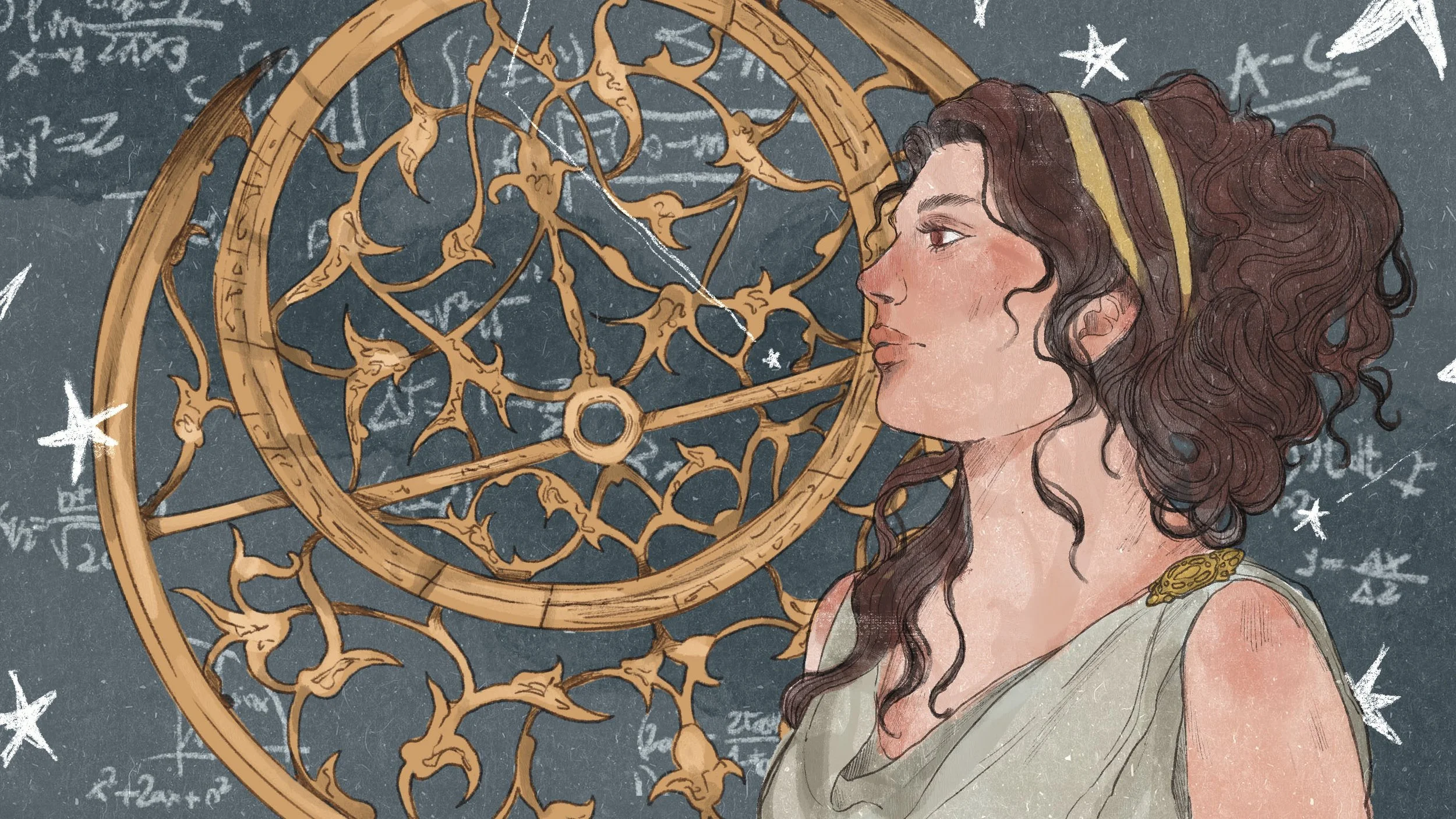
Hypatia of Alexandria
350–370 - 415 AD
Hypatia of Alexandria
Mathematician
Philosopher
Astronomer
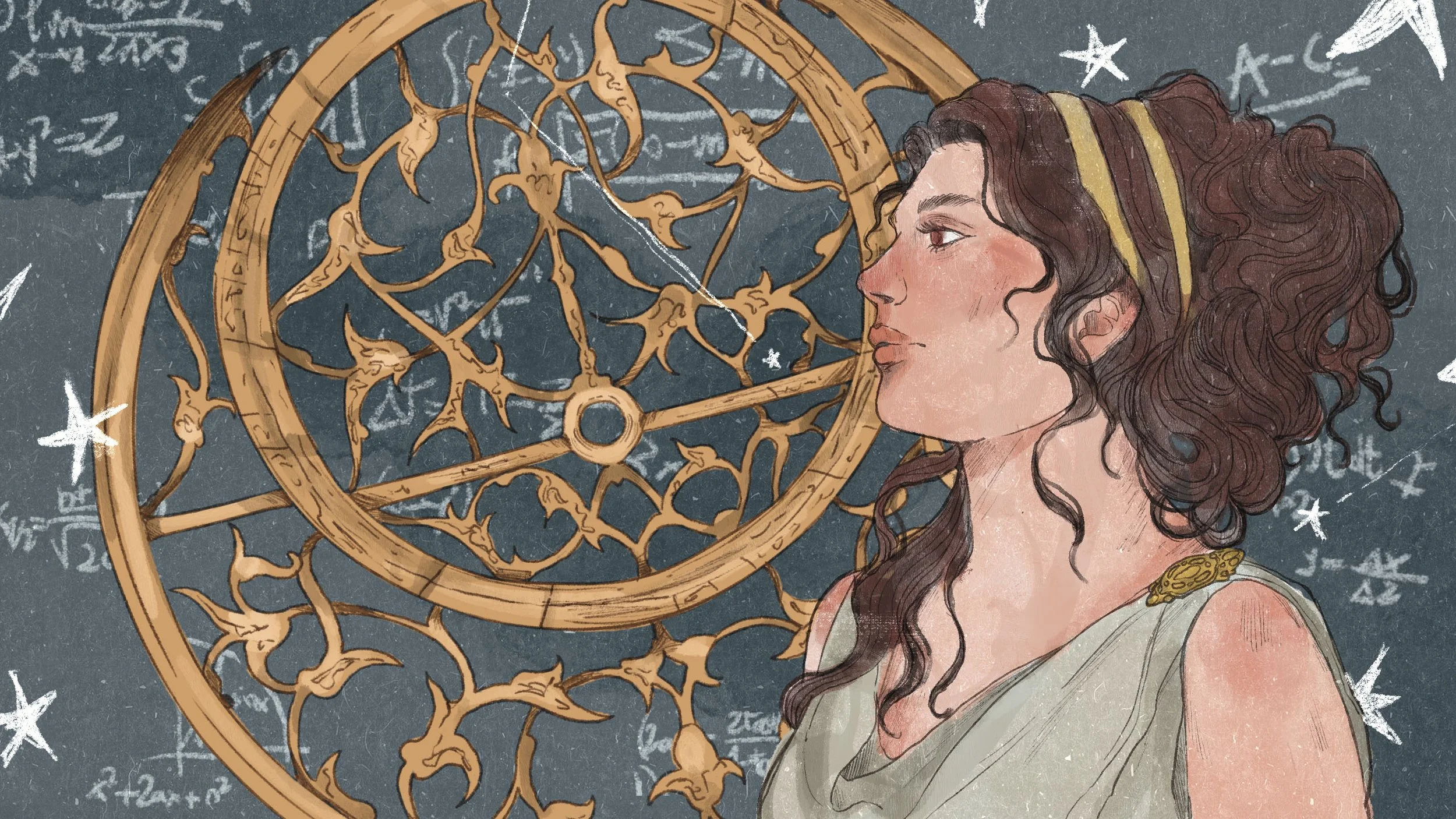
Portrait of Hypatia of Alexandria.
A City of Fire & InkTo understand Hypatia of Alexandria, it is necessary to begin with the city that shaped her.
Alexandria was more than the setting of her life. It formed her education, provided the public she served, and helped create the conditions in which she died. Within its boundaries, Greek mathematics, public philosophy, religious conflict, and the late survival of ancient scholarship converged. Any account of Hypatia that ignores Alexandria risks separating her from the conditions that made her intellectual life possible and the volatile environment that later engulfed her.
In the late fourth and early fifth centuries, Alexandria was a city suspended between worlds. It remained a capital of learning, but it was also increasingly defined by sectarian violence, political instability, and cultural rupture. Founded by Alexander the Great in 331 BCE, it had become a cosmopolitan center where Greek, Egyptian, Jewish, Roman, and later Christian traditions intersected. Its two great institutions, the Museum and the Library, once served as engines of scholarship, where mathematicians, astronomers, philosophers, and grammarians studied the order of nature. The Museum was not a museum in the modern sense, but an academic community supported by royal patronage. There, Euclid structured geometry, Eratosthenes measured the Earth, and Ptolemy systematized astronomy. Their works shaped intellectual life across the Mediterranean, sustained by generations of editors and commentators who preserved the Greek scientific corpus.
By the time Hypatia was born, this world was already fragile. The original Library had suffered repeated losses beginning with Julius Caesar’s siege in 48 BCE, and later political upheavals further damaged the city’s collections. Another major blow came in 391 CE, when Archbishop Theophilus, acting under imperial orders against pagan worship, oversaw the destruction of the Serapeum. The temple may have housed an important remaining collection of scrolls, though the extent of that loss remains debated. Alexandria’s intellectual infrastructure was steadily eroding.
The Museum survived in diminished form, and the last known scholar associated with it was Theon of Alexandria, Hypatia’s father. His commentaries on Euclid’s Elements and Ptolemy’s astronomical works helped conserve Greek mathematical knowledge at a time when original research was increasingly giving way to editorial preservation. Hypatia would inherit this environment, where preserving earlier knowledge had become an intellectual task in itself.
Alexandria itself was volatile.
By the end of the fourth century, Christianity had become the dominant religion of the Roman Empire, yet Alexandria remained ethnically and religiously diverse. Jews, Christians, pagans, and adherents of various philosophical traditions lived in uneasy proximity. The city had long been known for its quick tempers and descent into street violence. As Richeson observes, the Romans struggled to govern a place where even minor disagreements could erupt into full-scale riots involving ethnic or religious groups.
When Theophilus died in 412, Cyril succeeded him as bishop and intensified efforts to assert Christian dominance within the city. His tenure was marked by escalating conflict with Jewish communities, rival Christian sects, and the secular government. The civic balance that had sustained Alexandria’s intellectual life grew more precarious.
Hypatia’s story would soon become inseparable from these conditions. Her life unfolded in a city shaped by the remnants of classical learning and the pressures of political and religious transformation. Alexandria was a place defined by fire and ink, and in that precarious environment, she became one of the last great figures of its ancient intellectual tradition.
A symbolic rendering of the night sky recalls Hypatia’s work in astronomy and her study of the mathematical order of the cosmos.
Museums & ScrollsHypatia was born in Alexandria sometime between 350 and 370 CE, although the exact year remains uncertain. Ancient writers rarely documented the births of women, and even notable figures often entered the historical record only once they achieved public influence. Modern scholars estimate her birth by working backward from the well-attested year of her death in 415 and from astronomical observations recorded by her father, Theon, in 364. The identity of her mother remains unknown, a silence that likely reflects the broader gaps of ancient biographical tradition rather than anything specific to Hypatia.
Her father, Theon of Alexandria, was a prominent mathematician and astronomer and the last known scholar associated with the Museum, once the intellectual heart of the Hellenistic world. He devoted himself to preserving the Greek mathematical and astronomical corpus through editions and commentaries, most notably on Euclid’s Elements and Ptolemy’s Almagest and Handy Tables. Hypatia likely grew up in a household shaped by manuscripts, instruments, and the last remnants of Alexandrian academic culture. Although no direct sources describe her childhood, later accounts present her education as unusually rigorous. Theon is believed to have trained her in mathematics, astronomy, philosophy, rhetoric, and possibly physical discipline, though the more elaborate descriptions of daily regimens come from later retellings rather than contemporary testimony. What seems clear is that he recognized her intellectual gifts and cultivated them deliberately. Multiple ancient sources report that she eventually surpassed him, particularly in philosophical authority, a claim preserved in the Suda and supported indirectly by the praise of her students.
Debate has long surrounded the question of whether Hypatia pursued formal study outside Alexandria. The tenth-century Suda implies that she may have studied in Athens, but modern historians largely reject this interpretation because of chronological contradictions. Plutarch of Athens, the figure sometimes linked to this tradition, was teaching at a time when Hypatia was likely already lecturing in Alexandria. Most scholars, therefore, conclude that her education took place within her own city, under Theon’s guidance and within the intellectual networks that persisted despite Alexandria’s unrest.
By adulthood, Hypatia had developed a formidable breadth of learning. She possessed advanced mathematical training, a deep understanding of astronomy, and a command of philosophical traditions rooted in Platonism and later Neoplatonism. Her education prepared her to lead Alexandria’s Platonic school and to become one of the most influential intellectual figures of late antiquity. Those early years laid the foundation for a career that would leave a lasting mark on the Mediterranean intellectual world.
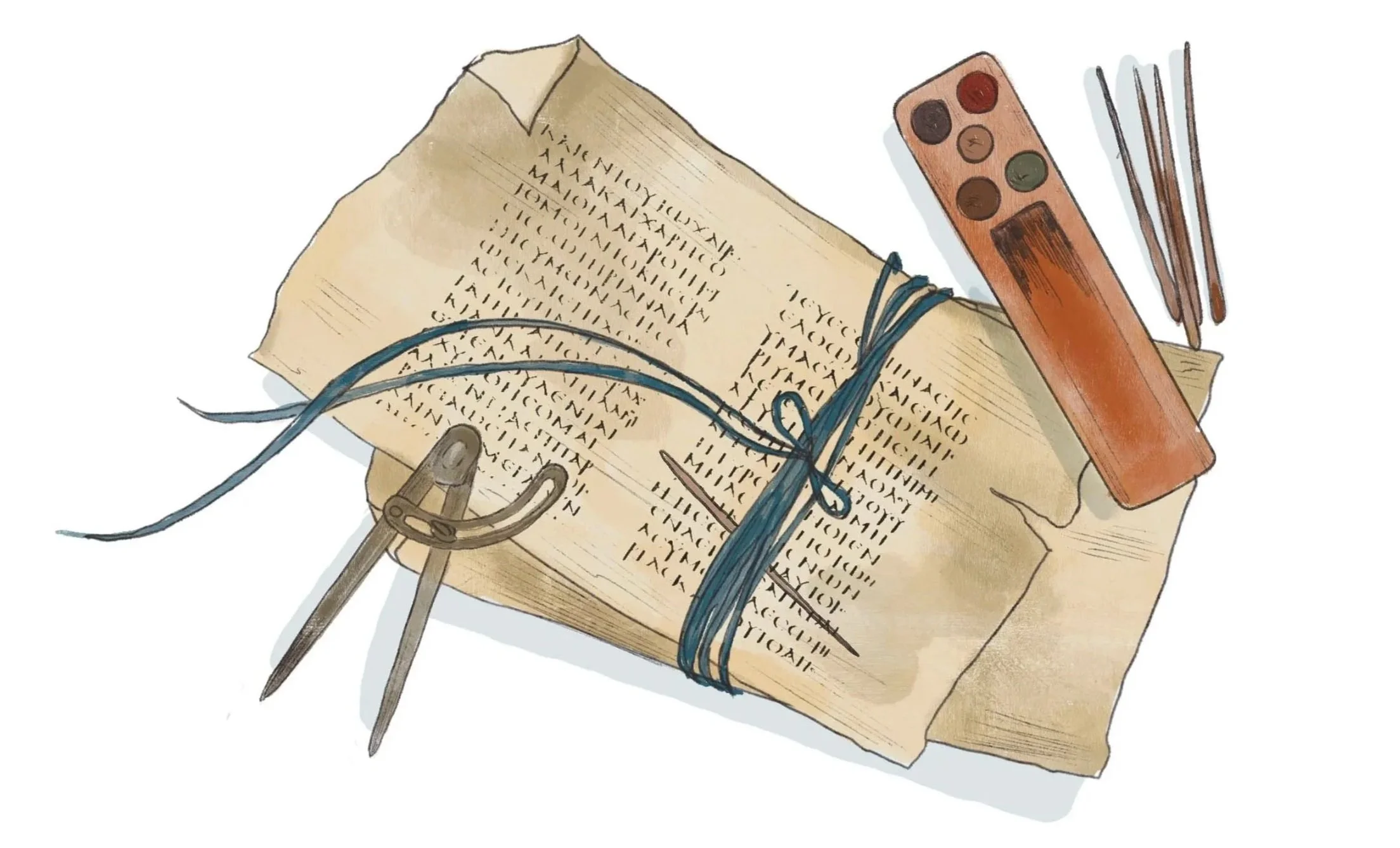
Before ideas become legacy, they pass through the hand: through scrolls unrolled, numbers traced, and instruments carefully made.
Under Unrequited SkiesBy the turn of the fifth century, Hypatia had become one of the most visible intellectual figures in Alexandria. She succeeded to the leadership of the city’s Platonic school, a role traditionally held by prominent philosophers and one that signalled both her scholarship and her standing among Alexandria’s educated elite. Her lectures drew students from across the Mediterranean, including Christians, Jews, and pagans, reflecting both the cosmopolitan character of Alexandria and the unusual respect she commanded across religious and cultural boundaries.
Ancient accounts describe her as a teacher of striking eloquence. Damascius, writing a century later, portrayed her as a philosopher who appeared at the centre of the city wearing the scholar’s cloak and expounding Plato and Aristotle to all who wished to listen. This imagery, repeated in multiple sources, testifies to the public nature of her role. As Socrates Scholasticus observed,
Philosophy in Alexandria did not unfold solely in lecture rooms. It spilled into streets, courtyards, and civic spaces, where Hypatia became a familiar presence, known for both clarity of argument and personal authority.
Writers in late antiquity and the early medieval period also commented on her physical appearance. The Suda described her as beautiful and fair of form, and later depictions amplified these features to near-mythic proportions. Modern historians caution against reading such descriptions literally, since ancient sources often linked physical beauty to moral or intellectual virtue. In Hypatia’s case, these descriptions function less as reliable biography than as a narrative way of underscoring her charisma and the appeal of her teaching.
Her celibacy and rejection of marriage, however, appear more firmly grounded. Several sources describe her commitment to a life of philosophical discipline, including abstention from marriage and family life. The most vivid anecdote concerns a young suitor whom she reportedly rebuffed by presenting a piece of her menstrual cloth and explaining the folly of valuing the body over the intellect. Although the story may contain embellishments typical of ancient biographical literature, it captures how later tradition understood her devotion to philosophy and the independence she embodied.
Hypatia’s prominence extended beyond the classroom. She was respected as a civic advisor, and among those who sought her counsel was Orestes, the Roman prefect of Alexandria. Their relationship, described by multiple sources as close and mutually respectful, reflected her standing within the city’s political life. Orestes was nominally Christian but politically moderate and committed to maintaining civic authority independent of ecclesiastical influence. His consultations with Hypatia were therefore significant in civic as well as intellectual terms, suggesting a partnership grounded in rational deliberation at a moment when Alexandria’s civic order was under increasing pressure.
Her visibility at Orestes’ side, combined with her philosophical influence and her refusal to align with any religious faction, placed her at the centre of Alexandria’s turbulent public sphere. Students admired her, citizens sought her guidance, and officials treated her as a voice of moderation and reason. Those same qualities also made her vulnerable in a city growing more polarized.
Alexandria’s skies, once shaped by the clarity of mathematical inquiry, were beginning to darken with the tensions that would ultimately converge upon her.
The Order Beneath All ThingsHypatia’s teaching was grounded in Neoplatonism, a philosophical tradition that shaped late antique thought and understood mathematics as more than a technical pursuit. Drawing on Plato and developed by figures such as Plotinus and Iamblichus, Neoplatonism described reality as a hierarchy descending from the One, through Nous and the World Soul, to the material world. Human souls, in this view, could turn back toward higher realities through disciplined reasoning and contemplation.
Within this framework, mathematics held a privileged place. It served as a bridge between the material and intelligible worlds, since its objects were abstract yet grounded in observable patterns. As Richeson explains, mathematics had the power to “transcend its beginnings,” offering a way to rise above physical uncertainty and approach unchanging truths. Geometry, astronomy, and arithmetic revealed forms of order and harmony that Neoplatonists believed were woven into the universe.
Hypatia inherited this tradition and brought to it a distinctive emphasis on the exact sciences. Her place within Alexandria’s Platonic school situated her in the lineage of Plotinus and Iamblichus, while her own teaching appears to have emphasized demonstration, precision, and method. While some Neoplatonists leaned more heavily toward mystical speculation, Hypatia grounded philosophical instruction in mathematical discipline. She taught abstraction through exactness and philosophical ascent through disciplined thought.
In her classroom, mathematics was more than knowledge to be mastered. It trained perception and character, teaching students to recognize order where ordinary experience saw confusion. It also demanded patience, self-command, and intellectual seriousness. Reason, in this sense, was both an intellectual and moral practice.
Something of this influence appears in the letters of her student Synesius, who later became a Christian bishop while continuing to express Neoplatonic ideas in his writings. In the surviving correspondence, he addresses her as,
a phrase that suggests both intellectual devotion and personal reverence
Through her teaching, Hypatia presented mathematics as a way of approaching cosmic order. In a city increasingly marked by discord and uncertainty, her classroom offered a disciplined counterpoint to the instability beyond it, a place where reason remained a living practice even as Alexandria moved toward conflict.
The Last Mathematician of AlexandriaBy the early fifth century, Hypatia had likely become the most respected mathematical scholar in Alexandria and one of the most accomplished mathematicians in the Greco-Roman world. Her reputation rests not on surviving treatises but on the intellectual labour that sustained Greek mathematics in an age when preservation had become more urgent than discovery.
The surviving sources describe her as an editor, teacher, commentator, and interpreter whose work helped secure the transmission of the Greek mathematical tradition rather than extend it into new theoretical terrain.
Ancient mathematical texts circulated within a tradition of commentary, in which scholars annotated, clarified, corrected, and reorganized earlier works for new generations of students. This was the world Hypatia inherited. Her father, Theon, had already produced influential commentaries on Euclid, Ptolemy, and other mathematical authors, and Hypatia appears to have continued this work. The tenth-century Suda preserves the titles of three writings attributed to her: a commentary on Diophantus’ Arithmetica, another on Apollonius’ Conics, and a commentary on an astronomical “canon,” possibly referring either to Ptolemy’s Handy Tables or to a revised treatment of Theon’s commentary on the Almagest. None survives, so her influence must be reconstructed from indirect evidence and later manuscript traditions.
Diophantus’ Arithmetica offers the clearest window into her editorial work, though the evidence remains fragmentary. Some nineteenth- and twentieth-century scholars argued that the surviving Greek manuscripts descend from Hypatia’s edition and that certain interpolations may preserve her explanatory notes. Two algebraic exercises at the start of Book II, for example, resemble material in Euclid’s Data, which Theon had edited, suggesting a link to Hypatia’s circle or teaching tradition. The theory remains debated, and more recent scholarship suggests a more complex transmission history, including the survival of some lost books in Arabic. Even so, her engagement with Diophantus appears to have helped carry elements of Greek algebra into later traditions.
Her commentary on Apollonius’ Conics is also lost, but its significance is easier to infer. Apollonius’ third-century BCE study of ellipses, parabolas, and hyperbolas was one of ancient geometry’s most sophisticated achievements and would later prove foundational for the study of planetary motion. By late antiquity, the Conics was technically demanding and not easily approached without guidance. A commentary by Hypatia would have made the text more accessible to students and preserved its methods within the Platonic school. Although its contents cannot be reconstructed, the work points to her command of advanced geometry.
Hypatia’s work in astronomy can be glimpsed more directly. The clearest evidence is the inscription to Book III of Theon’s commentary on Ptolemy’s Almagest, identifying that version as “the edition of my philosopher daughter Hypatia.” Theon appears to have replaced his earlier treatment with her revision, a gesture that signals both respect and recognition of her expertise. Whether this corresponds to the “astronomical canon” named in the Suda, or instead to a commentary on the Handy Tables, remains debated. In either case, the evidence shows that Hypatia helped maintain and refine the computational tools of ancient astronomy, used to predict planetary positions, calculate eclipses, and train new astronomers.
The letters of Synesius provide another glimpse of her scientific practice. Writing from Cyrene, he described the design of an astrolabe and attributed its concept to her instruction. He also requested a hydroscope built to his specifications. Although scholars debate whether this hydroscope was a hydrometer or another measuring device, the exchange suggests her familiarity with scientific instrumentation and with the construction, commissioning, or supervision of precise mechanical tools.
The astrolabe, which depended on stereographic projection to represent celestial motion on a two-dimensional plane, points to an applied mathematical sensibility extending beyond textual scholarship into observational science.

Suspended among planets and geometry, Hypatia stands within the symbolic universe her teaching helped make intelligible.
These glimpses also mark the limits of what can be known. No philosophical treatises survive, and no independent mathematical work can be attributed to Hypatia with certainty.
Later stories credit her with inventions or algorithms, such as an improved method of long division, but such claims lack supporting evidence and reflect a modern desire to imagine her as an originator rather than the preserver the historical record more clearly reveals. The destruction of libraries, the scarcity of manuscripts, and the fragmentary nature of late antique sources all make her personal contributions difficult to define with precision.
Within those limits, a clear portrait still emerges. Hypatia carried forward a mathematical tradition at a moment when the institutions that had supported it for centuries were weakening. She edited, taught, and transmitted the work of earlier mathematicians, worked with instruments that embodied the principles she taught, and anchored philosophical inquiry in mathematical demonstration. Her legacy lies less in the creation of new theories than in the survival and transmission of older ones.
In a world increasingly unstable for sustained scientific work, she stands as one of the last great representatives of the Alexandrian mathematical tradition.
Politics, Philosophy, & PerilIn 412 CE, Alexandria entered a period of acute instability. The death of Archbishop Theophilus opened the way for his nephew Cyril to assume the bishopric, a position of significant moral authority and growing political force. From the outset, Cyril sought to strengthen the Church’s influence within the city. He moved quickly against groups he viewed as threats to ecclesiastical authority, including the Novatians and Alexandria’s long-established Jewish community, which was expelled after violent conflict between Christians and Jews. His actions reflected a broader imperial trend toward Christian orthodoxy, but in Alexandria, they sharpened tensions rather than settling them.
Opposite Cyril stood Orestes, the Roman prefect of Alexandria. Although a Christian himself, Orestes resisted the intrusion of ecclesiastical power into civic governance. His efforts to preserve the division between church and civic authority brought him into direct conflict with Cyril. Modern historians describe their relationship as one of sustained rivalry and competing visions for Alexandria’s future. The conflict escalated when Nitrian monks loyal to Cyril attacked Orestes in the street. He survived, but the episode showed how readily religious zeal could become political violence.
Hypatia, already a prominent public intellectual, became entangled in this struggle. She had a well-attested relationship with Orestes, who sought her counsel on civic matters. Her reputation for clarity and judgement made her a natural advisor in a city under strain, but that association also placed her in the path of suspicion. As reconciliation between Cyril and Orestes failed, some Christians began to cast Hypatia as the obstacle to peace.
The accusation that she used magic or witchcraft to influence Orestes appears in the Chronicle of John of Nikiu, a seventh-century Coptic source. John portrayed her as a pagan scholar skilled in astrology and sorcery who had bewitched the prefect into opposing the bishop. He described her as,
Although this account reflects later theological anxieties rather than reliable evidence from Hypatia’s own lifetime, it shows how her public role could be recast through sectarian hostility. Neoplatonism, with its ties to contemplation, intellectual ascent, and pre-Christian philosophical traditions, was increasingly vulnerable to suspicion in Christianizing Alexandria.
Hypatia’s position as an independent female scholar likely heightened those tensions. Her authority came from philosophical training rather than ecclesiastical office, and her influence rested on learning rather than institutional hierarchy. As Alexandria’s factions hardened, her commitment to reasoned discourse and her refusal to align with any sect made her increasingly vulnerable. The intellectual openness that had once allowed her to teach Christians, Jews, and pagans alike was becoming harder to sustain in the city’s polarized climate.
As the struggle between church and civic power intensified, Hypatia came to signify more than her actual political role. She represented a form of authority rooted in inquiry, reputation, and education rather than doctrine or office. In a city where religious identity was becoming an increasingly important measure of loyalty, that kind of authority had grown vulnerable.
The stage was now set for her to be turned from scholar into symbol.
Bloodied HandsThe crisis that engulfed Hypatia reached its breaking point in March 415 CE, when the political tensions that had strained Alexandria for years turned deadly.
Her murder was not an isolated outburst.
It emerged from escalating conflict between civic authority and ecclesiastical ambition, intensified by public fear, factional loyalty, and hostility toward independent intellectual life. When the mob struck, it did so in a city already marked by turmoil, and the violence reflected forces far larger than any one individual.
Ancient accounts agree that the attack began when a group of Christian zealots confronted Hypatia as she travelled through the city in her carriage. They dragged her from the vehicle and took her to the Caesareum, a prominent church that had once been a pagan temple. Later sources differ in their precise details, but they agree on the extraordinary brutality of what followed. One modern summary, drawing on that tradition, describes the attack in stark terms:
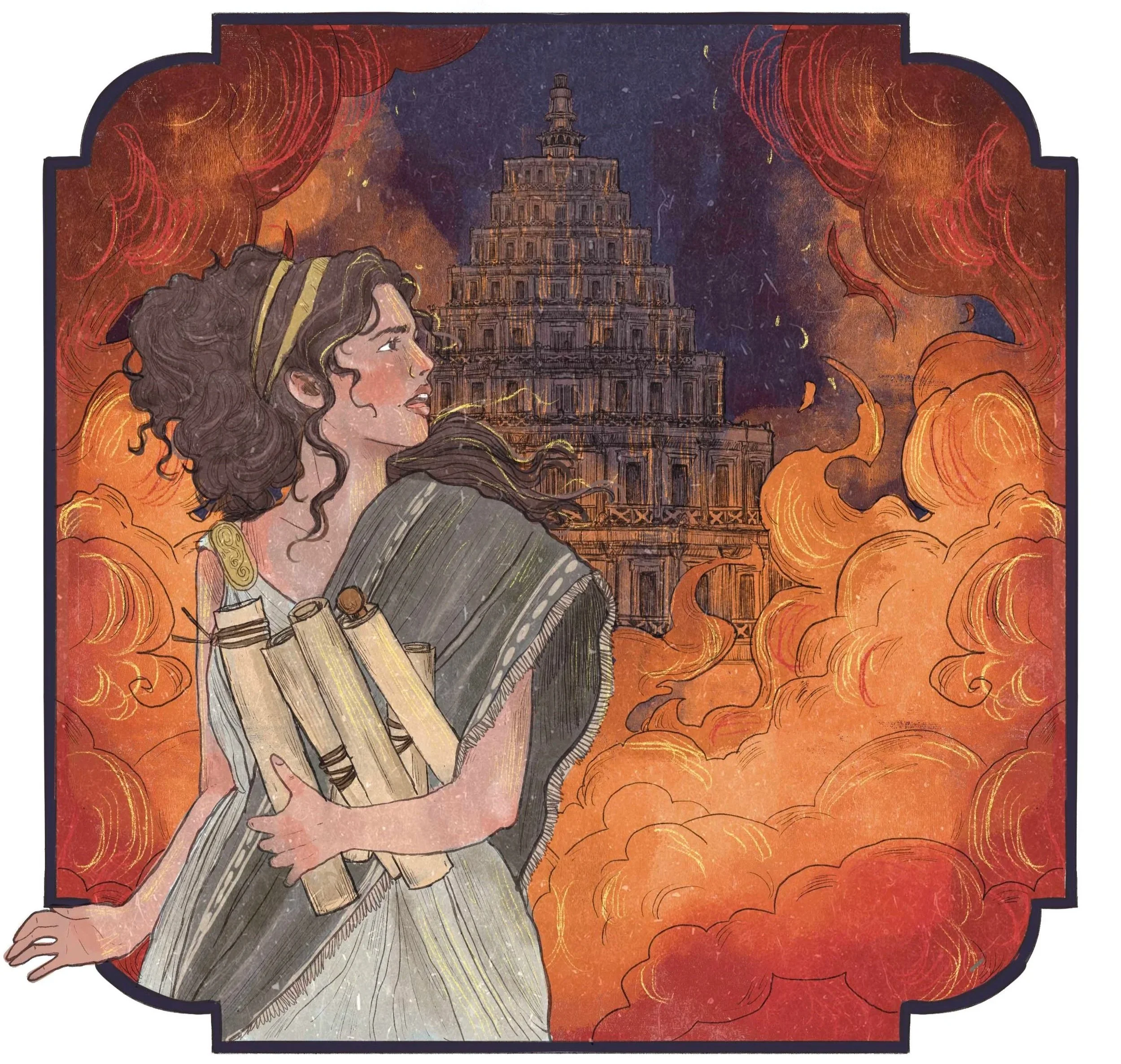
Alexandria burns as both city and symbol: a place where knowledge flourished, and where violence proved how fragile that flourishing could be.
Other versions mention roof tiles, pottery shards, or oyster shells, but the savagery of the murder remains consistent across retellings. The violence shocked even contemporaries, and later writers struggled to explain the fury behind it.
Several sources identify her attackers as members of the parabalani, a brotherhood of Christian volunteers officially charged with caring for the sick and burying the dead, yet increasingly notorious for acting as the bishop’s informal militia. The Theodosian Code later referred to the terror of those who are called parabalani. By the time of Hypatia’s murder, they had already been associated with violence and civic disorder. Their role in her death underscores how ecclesiastical influence could mobilize religious zeal into organized force.
The motivations behind the murder were embedded in Alexandria’s fractured political landscape. Cyril’s supporters believed that Hypatia had influenced Orestes and prevented reconciliation between the prefect and the bishop. Although there is no evidence that she pursued a political programme beyond offering counsel, the perception that she stood between church and civic power made her a symbolic target. In a climate of mounting suspicion, her independence could be recast as provocation.
Hostile narratives intensified that danger. The Chronicle of John of Nikiu, written centuries later, portrayed Hypatia as a philosopher who practiced magic and misled Orestes. John claimed she “beguiled many people through her Satanic wiles,” casting her intellectual activity as occult power. While this bears little resemblance to contemporary accounts that praised her dignity and virtue, it shows how her authority could be transformed into a threat. In such retellings, philosophy itself became suspect, especially when associated with pagan learning and public influence.
The question of Cyril’s responsibility remains debated. Some early traditions, later preserved in the Suda, suggest that envy of Hypatia’s influence contributed to the hostility surrounding her, and Fiorio notes claims that rumours of sorcery were encouraged at a time when astrology and divination were criminalized. Modern scholars differ on whether Cyril explicitly ordered the attack, but many agree that he benefited from the removal of a prominent figure associated with Orestes and did nothing to punish those responsible, even though the killers were closely tied to his faction. His silence, and later praise of him as a destroyer of idolatry, reveal how her murder could be read by some not as a crime, but as victory.
The consequences extended beyond Hypatia’s life. Richeson notes that many Christians in Alexandria were horrified, recognizing her death as a stain on the city and on the faith claimed by her killers. Deakin argues that her murder dealt a profound blow to Alexandria’s intellectual life, contributing to the dispersal of scholars and the weakening of the philosophical school. Orestes soon vanished from the historical record, likely recalled or displaced. Taken together, the destruction of the Serapeum and the killing of Hypatia have often been read as marking the end of Alexandria’s ancient philosophical prominence.
None of Hypatia’s works survives, and some later interpretations link that absence to a broader pattern of neglect, suppression, and loss affecting pagan literature in late antiquity.
Within that wider history of erasure, her murder came to signify more than the killing of an individual. For later readers, it became a symbol of intellectual suppression and of the vulnerability of learned women in moments of political and religious upheaval.
Hypatia’s end revealed how quickly a city famed for its learning could succumb to fear and faction.
The streets where she once taught became the site of her destruction. What died with her was not only a philosopher, but part of the fragile civic world that had made her life of thought possible. Her death remains a testament to the fragility of knowledge in times of upheaval and to the risks faced by women whose authority rests in intellect rather than office.
Rewriting of HypatiaHypatia’s death did not end her story.
It opened a long afterlife in which historians, polemicists, theologians, novelists, and activists repeatedly reshaped her image to serve their own purposes. The earliest Christian chroniclers recast her as a sorceress rather than a scholar. John of Nikiu, writing centuries later, described her as a woman devoted to magic, astrolabes, and instruments of music, a figure who bewitched Orestes and led Christians away from the Church. This reframing turned intellectual authority into spiritual danger and presented her murder as an act of purification rather than political violence. Such accounts helped produce a long medieval silence around her life and work.
The Enlightenment revived her for a very different purpose. Voltaire and Gibbon invoked Hypatia as evidence of clerical cruelty and the dangers of superstition. Her death became a symbol of what they believed Christianity had destroyed, a rhetorical weapon in arguments about reason, tolerance, and the decline of the ancient world. In the nineteenth century, Charles Kingsley’s novel Hypatia reshaped her again, casting her as a Protestant heroine whose beauty and purity stood against the corruption of the Roman Church.
Each retelling revealed at least as much about its own age as about the historical woman.
The twentieth and twenty-first centuries reclaimed her through feminism, secularism, and popular culture. The academic journal Hypatia positioned her as a foundational figure in the history of women in philosophy, a reminder that women have long been present in intellectual life despite recurring forms of erasure.
As one later reflection puts it, her name reminds scholars that,
Films such as Agora (2009) and digital retellings on public platforms present her as a martyr for science, rationality, and women’s autonomy, even when dramatization blurs historical boundaries.
These modern interpretations reveal a persistent tension. To commemorate Hypatia is often to reinvent her, and each generation has fashioned a version that answers to its own cultural struggles and political needs.
Across sixteen centuries, she has been transformed into sorceress, martyr, heroine, symbol, and warning. The rewriting of her life reveals as much about those who retold it as it does about the philosopher herself.
The Meaning of HypatiaHypatia’s name, derived from the Greek hypatē, meaning “the highest” or “supreme,” offers a fitting reflection of the intellectual world she inhabited and the aspirations later associated with her. It evokes altitude, elevation, and striving, themes that resonate through her Neoplatonic teachings, her mathematical discipline, and the life of ethical rigour she appears to have cultivated. Her name suggests ascent, and that image has often shaped the way her life has been remembered. Even in later tradition, she is remembered as insisting that,
Whether or not the words are hers, their persistence reflects the values later readers attached to her name: clarity of mind, intellectual seriousness, and a commitment to rational civic life.
What survives of her legacy is grounded less in original mathematical invention than in the intellectual virtues she came to represent. Her greatest influence appears to have come through teaching, commentary, and preservation rather than through surviving original research. She clarified and transmitted a mathematical tradition stretching from Euclid to Ptolemy, helping sustain Greek science at a moment when its institutions were weakening. Her life suggests that intellectual continuity often depends on teachers, editors, and interpreters, those who hold knowledge steady in periods of upheaval. As Richeson notes, even ancient Christian writers preserved an image of her extraordinary dignity and virtue, suggesting that her character endured even where her writings did not.
For women in the history of thought and science, Hypatia remains both inspiration and warning. Women’s participation in mathematics, astronomy, and philosophy has deep historical roots, even when documentation is sparse or later traditions obscure it. In that sense, the arc of her legacy reflects broader patterns in women’s history, including erasure, misattribution, mythmaking, and reclamation.
In modern memory, Hypatia remains a figure through whom later generations have measured both the endurance of knowledge and violence.
Her name carries the force of intellectual ambition, public courage, and the risks faced by those who refuse to surrender thought to power.
Fire consumed her writings. What it did not consume was the meaning of Hypatia of Alexandria’s life as a teacher, philosopher, and public witness to the discipline of thought.
We have authored and illustrated this entry with care and respect, aiming to achieve the highest standards through diligent, balanced research. We also strive to maintain the highest standards of accuracy and fairness to ensure information is diligently researched and regularly updated. Please contact us should you have further perspectives or ideas to share on this article.
-
Alic, M. (1986). Hypatia’s heritage: A history of women in science from antiquity through the nineteenth century. Beacon Press.
Bennett, A. (2021, June 20). Hypatia of Alexandria: The life and death of a female philosopher. The Collector. https://www.thecollector.com/hypatia-of-alexandria-life-death/
Bily, C. A. (2023). Hypatia [Research Starter]. EBSCO Research Starters. https://www.ebsco.com/research-starters/biography/hypatia
Deakin, M. A. B. (1994). Hypatia and her mathematics. The American Mathematical Monthly, 101(3), 234–243. https://doi.org/10.2307/2975600
Fiorio, S. F. (2019, January 16). The killing of Hypatia. Lapham’s Quarterly. https://www.laphamsquarterly.org/roundtable/killing-hypatia
Hansen, S. (2024, March 4). The first woman mathematician: Hypatia of Alexandria. Medium. https://medium.com/flamma-saga/the-first-woman-mathematician-hypatia-of-alexandria-1c06cdf423e7
Palta, P. (2025, April 17). Hypatia of Alexandria: Earliest female mathematician, lynched by a religious mob. India Today. https://www.indiatoday.in/education-today/gk-current-affairs/story/hypatia-of-alexandria-earliest-female-mathematician-lynched-by-a-religious-mob-2709831-2025-04-17
Richeson, A. W. (1940). Hypatia of Alexandria. National Mathematics Magazine, 15(2), 74–82.
St. Andrews University. (1999). Hypatia of Alexandria [Biography]. MacTutor History of Mathematics Archive. https://mathshistory.st-andrews.ac.uk/Biographies/Hypatia/
TED-Ed. (2019, June 5). Who was Hypatia? [Video]. YouTube. https://www.youtube.com/watch?v=n1mwZrVJ-TI
Watts, E. J. (2017). Hypatia: The life and legend of an ancient philosopher. Oxford University Press.
Zielinski, S. (2010, March 14). Hypatia, ancient Alexandria’s great female scholar. Smithsonian Magazine. https://www.smithsonianmag.com/history/hypatia-ancient-alexandrias-great-female-scholar-10942888/
-
Website Name: The Matilda Project
Title of Entry: Hypatia of Alexandria, Numbers and Philosophy: The Last Mathematician of Alexandria
Author: Shehroze Saharan
Illustrator: Giulia Martini (Julsiji)
Original Publication Date: May 04, 2026
Last Updated: May 04, 2026
Copyright: CC BY-NC-ND
Webpage Specific Tags: Hypatia of Alexandria; Mathematician; Philosopher; Astronomer; Neoplatonism; Platonism; Alexandrian mathematics; Ancient mathematics; Ancient astronomy; History of mathematics; History of astronomy; History of philosophy; Women in science; Women in mathematics; Women in philosophy; Women in STEM; Women in antiquity; Ancient women scholars; Greek science; Hellenistic scholarship; Late antiquity; Alexandria; Library of Alexandria; Museum of Alexandria; Serapeum; Theon of Alexandria; Euclid; Ptolemy; Diophantus; Apollonius of Perga; Almagest; Arithmetica; Conics; Astrolabe; Hydroscope; Synesius of Cyrene; Orestes; Cyril of Alexandria; John of Nikiu; Socrates Scholasticus; Damascius; Suda; Pagan philosophy; Christian Alexandria; Religious conflict in antiquity; Political violence; Intellectual history; Public philosophy; History of women intellectuals; Erasure of women in history; Gender and knowledge; Philosophy and mathematics; Ancient education; Classical learning; Transmission of knowledge; Commentary tradition; Scientific instruments; History of science; History of ideas; Intellectual legacy; Martyr for learning; Death of Hypatia; Alexandrian school; Women and authority; Gender and scholarship
Website Tags: The Matilda Project, The Matilda Effect; Margaret W. Rossiter; Matilda Joslyn Gage; Implicit bias; Unconscious bias; Gender attribution bias; Scientific recognition bias; Gender discrimination in academia; Stereotype threat; Pay gap in STEM; Glass ceiling in science; Sexism in scientific research; Gender stereotypes in education; Gender bias in peer review; Bias in STEM hiring practices; Impact of gender bias on scientific innovation; Underrecognition of female scientists; History of women in science; Women scientists in history; Notable women in science; Pioneering women scientists; Women Nobel laureates; Female role models in science; Gender disparities in scientific research; Women's suffrage movement; Historical women's rights leaders; Historian of science; STEM gender gap; Women in STEM; STEM education; Challenges faced by women in STEM; Representation of women in tech; Initiatives to support women in STEM; Gender equity in STEM education; Encouraging girls in STEM; STEM outreach programs; Diversity in STEM curriculum; Equity, Diversity, Inclusion; Equity in education and workplace; Diversity training; Inclusion strategies; Inclusive leadership; Gender equality; Racial equity; Pay equity and transparency; Representation in media.
-
APA Citation:
Saharan, S. (2026, May 4). Hypatia of Alexandria, Numbers and Philosophy: The Last Mathematician of Alexandria. The Matilda Project. https://www.thematildaproject.com/scientists/hypatia-of-alexandria
Author
Shehroze Saharan
Senior Manager, Institutional AI Strategy Development and Support, Office of the Vice-President, Digital Transformation and Chief Information Officer at George Brown Polytechnic
Shehroze Saharan is the Senior Manager, Institutional AI Strategy Development and Support at George Brown College, where he leads the development and implementation of a college-wide strategy for the ethical and strategic integration of artificial intelligence across academic and operational environments. His work spans AI research and policy, adoption support, employee training, and faculty engagement, while also advising senior leadership on aligning AI initiatives with the college’s broader digital transformation agenda.
Previously, Shehroze served as Educational Technology Developer at the University of Guelph, where he was the institution’s pedagogical lead on AI in Education (AIED). He is also the founder and leader of the Teaching with Artificial Intelligence Conference, now the largest AI in Education event in Canada.
Shehroze holds a Master of Information from the University of Toronto and a Bachelor of Science in Biomedical Science from the University of Guelph. He is currently completing his Ph.D. at the Ontario Institute for Studies in Education (OISE), University of Toronto, where his research explores Generative AI in curriculum and pedagogy.
Beyond his institutional role, Shehroze is the Managing Director and Co-Founder of The Matilda Project, an award-winning open educational initiative that highlights the contributions of historically overlooked women in science.
Illustrator